
Your El Rio
We Love Helping People.
It’s all about making a lasting difference in our patients’ lives.
El Rio Health’s Mission is to improve the health of our community through comprehensive, accessible, affordable, quality and compassionate care. Our Vision is to be a national model of excellent healthcare.
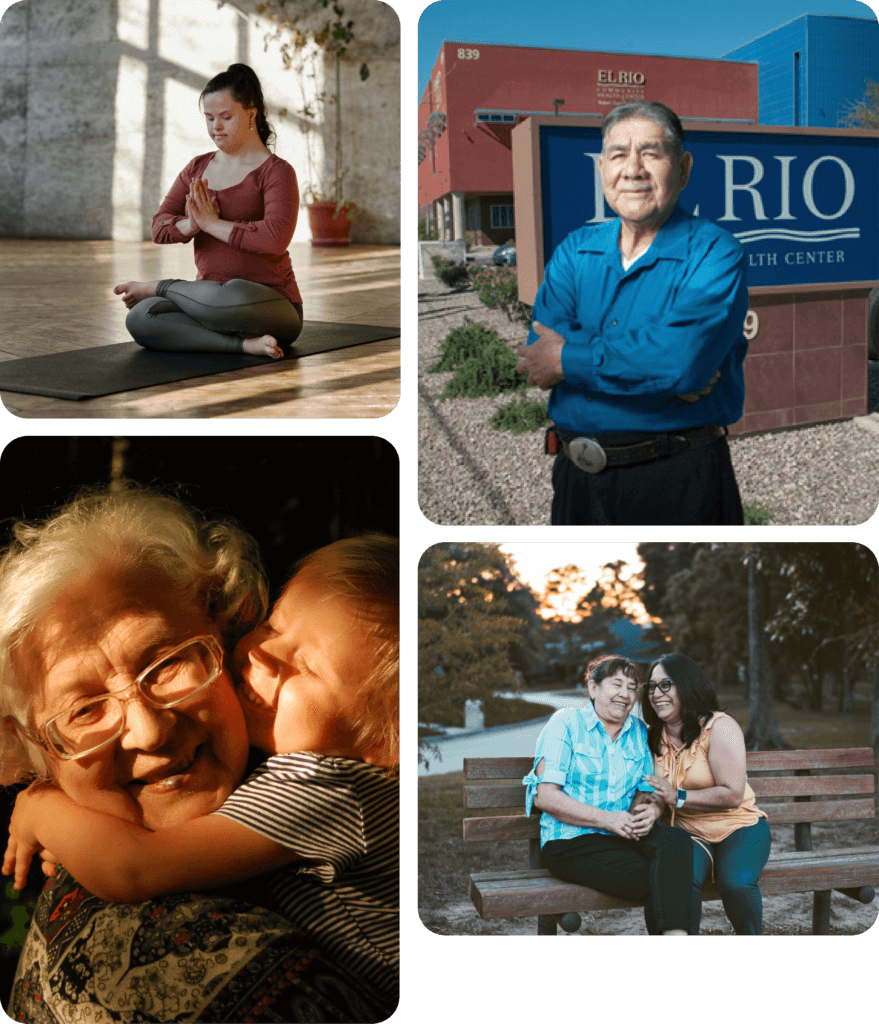
We are dedicated to providing healthcare for all people. Since El Rio began in 1970, we have grown to serve one out of every ten Tucsonans. We are proud to be one of the most innovative, highly regarded, non-profit health centers in the United States. We focus on positive outcomes, treating the whole person. Our healthcare is delivered by compassionate, professionally trained, integrated health teams who give from their hearts to provide world class care. “Your Health is Our Passion.”
Today, approximately ten percent of Tucsonans trust us with their care. El Rio receives funding from many health insurers, patient co-pays from our sliding fee scale, government grants and private donations to El Rio Health Center Foundation.
El Rio Health is a Federal T ort Claims Act Deemed Facility. This health center receives HHS funding and has Federal Public Health Service (PHS) deemed status with respect to certain health or health-related claims, including medical malpractice claims, for itself and its covered individuals.
Mission
To improve the health of our community through comprehensive, accessible, affordable, quality and compassionate care.
Vision
To be a national model of excellent healthcare.
Since 1970, El Rio Community Health Center has provided quality, accessible healthcare.
In the late 1960s, President Lyndon B. Johnson declared a “War on Poverty” and the concept of neighborhood health centers was born.
Against this national backdrop, local advocates on the west and south sides of Tucson were building new communities in the barrios and fighting for basic services, including healthcare.
At the same time, the founding dean of the new College Of Medicine at the University of Arizona – Dr. Merlin DuVal – wanted a new way to train young medical students and saw that a neighborhood health center would provide that opportunity while serving the healthcare needs of the underserved. He enlisted the help of Dr. Herb Abrams who had already worked with a community in Chicago to build one of the first centers there. Abrams connected with local leaders in the barrios and enlisted their support.
With the donation of a building by Pima County and $50,000 for renovations, along with a federal grant, the first El Rio neighborhood health center opened in October of 1970 with a small staff of health professionals offering primary medical and dental care. El Rio Health is now one of the largest, most highly regarded integrated health centers in the country.
Video Transcript
Video Title: El Rio History
Length: 7:01
Link to YouTube page: https://www.youtube.com/watch?v=f0U9SFpk26g
Transcript
[0:00] [Visual & Music]: A purple tree with branches that form circles against a neutral background. Small purple hearts and bubbles float among the branches. The El Rio Health logo appears and grows next to it, with the text “Established in 1970,” to the opening chords of the song “Fortunate Son,” by Creedence Clearwater Revival.
[0:08] [Visual & Music]: Historic black and white footage with the text: 1963 – March on Washington. The music continues with vocals, and the sound of the crowd in the background. Protesters march alongside the Washington, DC, reflecting pool with the Washington Monument in the background. A close shot shows a group of men and women holding protest signs denouncing Jim Crow and demanding integrated schools, jobs, and freedom. Video clips are replaced with historic still photos from the march.
[0:20] [Female narrator]: Fueled by the Civil Rights movement of the 1960s, several neighborhood groups in Tucson south of West Sides were emboldened.
[0:22] [Visual]: Period newspaper showing headlines: Birmingham Seethes – – Hate-Triggered Church Blast Kills 4 Little Girls. King Asks For Federal Intervention. F.B.I Sent In, Guard Put On Alert, Mayor Asks State Troops. “Kills 4 Little Girls” text is highlighted, and view zooms in on a historic photo of a black family, then pans down across other headlines such as “Marshals Sent To Alabama,” “Freedom Rider Beaten,” and “20 Beaten In Newest Mob Fury.” Newspaper page folds back to show a historic photo from a Tucson protest at the time, with a large banner reading “Our Fight is at Home, Not In Viet Nam!” Smaller banners in English and Spanish give messages such as “Basta! No More War!” and “Chicano Power!”
[0:29] [Female narrator]: At the same time, Tucson elected officials were making major decisions about the city’s future. Diverse community leaders were demanding a seat at the table.
[0:31] [Visual]: Historic monochrome footage of downtown Tucson from the air, showing city buildings stretching out to distant mountains, with the caption “1970 Tucson Skyline.”
[0:37] [Visual & Audio]: Historic footage of Tucson Civil Rights protests. Citizens hold signs such as “Brown & White, Unite & Fight” and “Mi Raza Primero!” as they march. Tense Latin guitar music begins. Additional photos show signs with slogans such as “Unidad,” “The Time is Now,” and “Viva la Raza.”
[0:48] [Visual]: Historic black and white photograph of two men being arrested by police in Tucson, presumably during a protest. One man is shirtless, and both look worried.
[0:51] [Jaime Gutierez]: There was a lot of, um, uh, changing, wanting to change, the status quo. Um, obviously healthcare is one of those markers of a healthy community, of a community that thrives, and um…healthcare was almost nonexistent for West Side and South Side residents.
[0:53] [Visual]: Jaime Gutierez speaks to the camera. Text on screen identifies him by name, and indicates he was an “Original El Rio Board Member.” Additional historic photos from Tucson during that period appear briefly, children and community members interacting with medical professionals, before returning to Mr. Gutierez.
[1:14] [Female narrator]: Jaime Gutierez was just out of college when he joined other, more seasoned community activists, who were organizing to find ways to increase even just basic healthcare on the South and West sides of Tucson. The stars aligned, and a major Federal funding door opened.
[1:14] [Visual]: Black and white photo of Mr. Gutierez as a young man. His photo is joined by similar photos representing other community activists. A photo of a female doctor examining a young girl fills the center of the screen.
[1:32] [Visual]: Screen text: President Lyndon Johnson delivers the State of the Union Address. Historic photo of President Johnson delivering his address to Congress, and additional photos of President Johnson meeting with community members and Civil Rights activists in different settings. As President Johnson begins to speak, text appears: Voice of Lyndon Johnson, 36th U.S. President.
[1:35] [President Lyndon Johnson]: And this administration today, here and now, declares unconditional war on poverty in America. [Applause].
[1:42] [Female narrator]: Text atop historic photographs: Courtesy of: LBJ Presidential Library
[1:48] [Female narrator]: President Johnson’s War on Poverty initiative was making major grants available to build healthcare centers in under served communities all over the nation. Members of several neighborhood groups on the South and West sides eventually united, and approached the newly opened University of Arizona Medical School. Now while the University had access to the resources and could apply for a Federal grant, it did not have the trust of the neighborhood groups.
[1:48] [Visual]: Historic black and white photos: President Johnson from an address; a female doctor uses a stethoscope on a young woman; two young girls look up from playing.
[1:59] [Visual]: An engraved sign reading “El Rio Santa Cruz neighborhood health center & health care plan” with a steel frame building under construction in the background in a historic photo. Image splits and retracts into corners, revealing a black and white photo of the College of Medicine building and grounds.
[2:11] [Visual]: A group of men in suits use oversized scissors during a ribbon cutting ceremony at an undisclosed location, likely the new University.
[2:17] [Visual& Audio]: Aerial view of the new University campus. “Ball of Confusion” by The Temptations begins to play: “Segregation, determination, demonstration, integration. Aggravation, humiliation, obligation to our nation. Ball of confusion…” Historic photos from Civil Rights marches and protests in Tucson are shown.
[2:26] [Female narrator]: The memory of the demolition of entire downtown barrio areas to build the Tucson Civic Center was still fresh on the minds of community activists.
[2:26] [Visual]: Text: 1968. Color footage from several angles of a home being demolished. Historic photos of construction, showing heavy machinery digging a foundation in the midst of other buildings.
[2:37] [Dr. Herb Abrams]: Hundreds of homes had been razed, and people had been forced to move elsewhere, and they were, uh…uh, many people were quite angry about that.
[2:37] [Visual]: Historic footage of construction machinery removing rubble as buildings are demolished.
[2:44] [Visual]: Interview with Dr. Herb Abrams, identified as “El Rio – First Medical Director, U of A Medical School.” Interview is inset over a black and white photo of the Tucson campus.
[2:48] [Female narrator]: Dr. Herb Abrams was there, in the trenches, representing the University of Arizona. He was attempting to build trust, so that together the neighborhood group and the University could apply for the Federal funds to start…
[2:50] [Visual]: Interview window replaced by a black and white photo of Dr. Abrams as a younger man.
[2:57] [Visual]: Dr. Abrams photo replaced by a black and white image of a community meeting, with citizens seated at tables listening to a presentation.
[3:05] [Female narrator]: …a community health Center.
[3:05] [Visual & Audio]: Historic photos of doctors, activists, and a reuse of the female doctor using a stethoscope on a young girl. Soft, peaceful guitar music begins to play in the background.
[3:08] [Visual]: Black and white photo of a toddler drinking from a bottle in a waiting room, with a variety of adults and another child seated behind him.
[3:09] [Female narrator]: Pima County also pitched in. Supervisors donated $50,000 to renovate the empty county juvenile detention center. In a twist of fate, the jail cells were the perfect size for examining rooms.
[3:12] [Visual]: Historic newspaper with headlines, “Changing Tucson” and “Neighborhood Health Center. The change agent: Herb Abrams!”
[3:18] [Visual]: Black and white photo of the Pima County Justice Bldg, per the sign on the front of the building. Photo of the jail cells slides in and overlays the main photo in the upper right corner, joined by a photo of a medical examining room below it.
[3:26] [Dr. Herb Abrams]: And fixing them up so after it was all remodeled, you could never tell that it had recently been a jail.
[3:27] [Visual]: Pima County Justice Bldg photo fades out and interview clip with Dr. Abrams fills space to the right of the jail and exam room photos.
[3:35] [Visual]: Fade through black to show the El Rio Health logo in a grid of historic monochrome photos connected to El Rio’s past and present. Text “Established in 1970” appears from a burst of blue light in the middle of the grid.
[3:36] [Female narrator]: And so it began.
[3:39] [Dr. Herb Abrams]: One of the requirements of the poverty program was that the health center should be controlled by boards of people living in the neighborhood, people representing the, the potential patients in the area.
[3:42] [Visual]: Dr. Abrams speaks to the camera while images from El Rio’s history appear beside him.
[3:54] [Female narrator]: Miguel Rojas was also one of the original incorporators of El Rio Health.
[3:44] [Visual]: Miguel Rojas speaks during a community event, with other participants in the background.
[4:00] [Miguel Rojas]: We started working these committees together, and they started naming committees…they start putting some of our board members or staff in some of their committees, and they said, well, you know, I think we’re communicating now, we’re working.
[4:02] [Visual]: Miguel Rojas speaks to the camera. Text on screen identifies him by name, and “El Rio Health, An Original Incorporator.”
[4:11] [Visual]: Community members seated at tables arranged in a square share a meal. One table holds flowers and photographs, and a clipboard.
[4:14] [Nancy Johnson]: We’re standing on the shoulders of all the leaders who have been here and had a vision for community and taking good care of the community.
[4:17] [Visual]: Nancy Johnson, RN, PhD speaks to the camera. Text on screen identifies her by name, and as “Former Chief Executive Officer” of El Rio Health.
[4:21] [Female narrator]: What started in a remodeled juvenile detention center with just a few clinicians today has become one of the major community health care success stories in the country.
[4:22] [Visual]: Newspaper clipping with headline “Federal Grant Assures Health Center Opening.” Joined by El Rio Health logo and a reuse of the Pima County Justice Bldg. photo.
[4:27] [Visual]: Blur effect removes the images and replaces them. El Rio Health logo now at center, surrounded by a collage of 6 other images of El Rio Health buildings, all with modern architecture.
[4:34] [Clinton Kuntz]: Now, El Rio started, you know, in humble beginnings in the southeast side of Tucson to serve the under served. And that’s still our mission today, we’re still as needed or more needed than ever.
[4:35] [Visual]: Clinton Kuntz speaks to the camera alongside historic photos of El Rio and the El Rio Health logo. Text on screen identifies him by name, and as “El Rio – Chief Executive Officer.”
[4:44] [Female narrator]: The real value of El Rio Health is measured just one patient at a time.
[4:45] [Visual]: Exterior footage of El Rio Health’s Cherrybell facility on an overcast day. Photos of medical staff and patients appear in a collage atop the footage.
[4:51] [Virginia Rodriguez]: So my name is Virginia Rodriguez, um, and I’ve been going to El Rio for, off and on for fifty years. I started going there when, uh, I was gonna have my son Conrad.
[4:54] [Visual]: Virginia Rodriguez speaks to the camera while seated, wearing a protective cloth face mask. She is surrounded by photos from El Rio’s history, the El Rio logo, and a photo of herself as a younger woman.
[5:01] [Visual]: Ms. Rodriguez’s interview is replaced by a photo of her son Conrad, wearing a face mask, while an El Rio staff member, also masked, listens to his chest with a stethoscope.
[5:05] [Conrad Rodriguez]: I’m Conrad Rodriguez, um, I’m an El Rio patient. I have been for the duration of my lifetime, that is, fifty years.
[5:06] [Visual]: Conrad Rodriguez speaks to the camera.
[5:13] [Visual]: Conrad Rodriguez and an unidentified young woman sit at a table with Virginia Rodriguez, who is masked. The table holds framed photos of an elderly man, and an elderly woman in black and white.
[5:14] [Female narrator]: Four generations of the Rodriguez family have counted on El Rio Health for almost all their medical needs.
[5:22] [Conrad Rodriguez]: Uh, my great grandmother, um…she lived in Marana. Uh, my aunt used to bring her down, uh, in the early 70s to 80s. Um, my grandfather, again up until his dying day, was an El Rio patient.
[5:23] [Visual]: The left side of the screen shows a college with the El Rio logo, photos from across its history, and the text: Established in 1970. The right side shows the photo of the elderly woman in black and white from the previous scene, identified now as Mr. Rodriguez’s great grandmother.
[5:30] [Visual]: Photo of Mr. Rodriguez’s great grandmother is replaced with a photo of his grandfather, grinning and holding a guitar.
[5:36] [Alicia Rodriguez]: My name is Alicia Rodriguez and…the last time I went to an El Rio facility was on Wednesday. They treat me like… a family member.
[5:37] [Visual]: Side by side photos of Alicia Rodriguez slide in. One the left she lays on the ground with her head resting on a black dog. On the right, a portrait of her smiling. Both photos are in black and white.
[5:41] [Visual]: Alicia Rodriguez speaks to the camera.
[5:48] [Conrad Rodriguez]: We make those [pauses] relationships again, whether it be with the nurse practitioner, with the doctor, with the dental hygienist, whether it be with the dentist. Those, those aren’t just…that’s patient 4567. That’s Alicia, that’s Conrad, that’s Virginia. They know you.
[5:49] [Visual]: Photo of Alicia and Conrad Rodriguez posing together against a pink background, both smiling.
[5:54] [Visual]: Mr. Rodriguez again speaks to the camera with the El Rio Health logo college in the background.
[5:59] [Visual]: Screen slides to black. El Rio Health logo and photo college returns on the left, with images of Alicia, Conrad, and Virginia Rodriguez on the left, from their interviews.
[6:06] [Nancy Johnson]: It’s an honor, right. Um, it’s, um…very important to be able to take care of generations of people in the community.
[6:07] [Visual]: Screen slides to black, and Nancy Johnson appears, speaking to the camera. Four photos of children posed for portraits fill in the space around her video as she speaks. Screen fades to black as Ms. Johnson finishes speaking.
[6:15] [Clinton Kuntz]: El Rio has grown from one single clinic to sixteen different clinics now. Most of them are fairly large in size, offer very integrative, comprehensive services. And we’re looking every day of how we can expand those, and how we can, you know, bring more services to the community.
[6:16] [Visual]: Mr. Kuntz appears speaking to the camera in the bottom left corner, while images of El Rio’s sixteen facilities appear one by one in a grid around him. The facility photos are are bright and modern in appearance.
[6:30] [Visual]: Fade to black, and then a sunrise video plays, with the sun rising from behind saguaro cactus in a desert scene.
[6:32] [Clinton Kuntz]: We want to be seen as the spot that everybody can go to get help there. Whether you are the mayor of Tucson, the governor of Arizona, it doesn’t matter. Somebody working at the supermarket, or somebody living in the wash who has no means at all, we’re here to take care of them.
[6:36] [Visual]: City of Tucson, founded 1775 logo slides in from the left, followed by the Great Seal of the State of Arizona – 1912.
[6:42] [Visual]: Image of a supermarket worker in a protective face mask slides in the from the left, followed by a photo of a homeless encampment. In the background, the rising sun is behind the saguaros.
[6:45] [Visual]: A neutral background appears and the purple tree from the opening reappears, unfurling its branches and growing as the El Rio Health logo appears and grows alongside it. Floating hearts and bubbles appear and move within the tree branches. Text “Established in 1970” appears below the El Rio Health logo, then grows off the screen as it fades to black, and the guitar music fades.
[6:52] [Visual]: Screen remains black and silent.
Video Transcript
Video Title: Faces of El Rio Health
Length: 2:21
Link to YouTube page: https://www.youtube.com/watch?v=5UchmA4u-d4
Transcript
[0:00] [Visual]: Individuals speak to the camera in an interview setting against a white background.
[0:11] [Male speaker 01]: That the US health care system [pause] is not just broken, it is fundamentally set up in a very wrong way.
[0:27] [Female speaker 01]: El Rio as a health care organization gets it. They understand the importance of, this person is here to talk to somebody, and not be a number and not have their appointment, you know, just churning through everything so the metrics look good. Like, they care about the person holistically.
[0:27] [Male speaker 02]: El Rio welcomes everybody, no matter what. If you have any ailments, you have… you walk in, somehow, some way they are going to put you on a siding scale, they’re going to do something so that you can get seen and you can get care.
[0:41] [Male speaker 03]: Fifty-five years ago when El Rio first opened, there was a need in this area for medical services.
[0:48] [Male speaker 04]: There wasn’t a doctor south of Broadway when El Rio started, and the neighborhoods were upset. The neighbors put El Rio together, and El Rio came from the people.
[0:59] [Female speaker 02]: The word was out that, hey, there’s a, there is a place where you can go and get quality, affordable medical care.
[1:07] [Male speaker 03]: And now it’s grown…the popularity has grown so that we have fourteen sites, um, within Pima County.
[1:16] [Female speaker 03]: What makes El Rio special is that… the people who are serving the patients are deeply dedicated to making sure that everyone has access to health care.
[1:28] [Male speaker 02]: In the mix of everything, that’s when I really saw that El Rio was amazing, when it came to wanting to provide that quality care.
[1:35] [Female speaker 02]: Care. That, to me, was the most outstanding feature, difference, that I noted.
[1:42] [Male speaker 01]: Not just in care that says what’s wrong with you, but care that says what’s right with you, and how do we support that.
[1:52] [Male speaker 03]: You go to a doctor and they send you to a lab or they send you for another specialist, and here, it’s… it’s all here.
[2:00] [Female speaker 03]: You can get medical care, behavioral health and dental care, and I personally have accessed all of those three areas.
[2:06] [Male speaker 04]: We want to provide good care to everyone, regardless of that, their ability to pay for it or not. We believe that everybody has that… that right to healthcare. That is our mission today.
[2:18] [Visual]: Speaker 02, a Latino gentleman with graying hair and a beard, sits with a smiling young girl who holds a sign which reads “ElRio55”.
[2:20] [Visual]: Short fade to black as video ends.